
Managing Invasive Species: Japan’s Battle Against Florida’s Green Anole

Updated: Dec 18, 2024

Invasive species can have profound impacts on ecosystems, often disrupting the natural balance and threatening native wildlife. Japan’s Ogasawara Islands have faced such a challenge with the invasion of the Green Anole, Anolis carolinensis. These islands are approximately 7,400 miles (11,900 kilometers) from South Florida, as the crow flies. A Green Anole, moving continuously without rest at its typical walking pace, would take about 4.7 years to travel the straight-line distance between South Florida and the Ogasawara Islands. Yet, through human intervention, Green Anoles made their way to the islands far more quickly.
Introduced to the Ogasawara Islands in the 1980s, a few short decades after the Northern Curly Tail was introduced to Palm Beach County. Since that time, the Green Anole has disrupted the islands' delicate ecosystems leading to the near extinction of several native species, including the Celastrina ogasawaraensis butterfly and several other endemic dragonfly species. Further, the Green Anole competes directly with the endangered native lizard, Cryptoblepharus boutonii nigropunctatus, fighting for habitat and resources.
South Florida shares many climate similarities with Japan’s subtropical Ogasawara Islands. Each region boasts warm temperatures, high humidity, and diverse ecosystems. These features make them prime targets for invasive species. In South Florida, species like the Cuban tree frog and Burmese python have disrupted local ecosystems in ways similar to how the Green Anole has impacted Japan. While Florida has its own invasive species challenges, we must consider how native species from one region, like the Green Anole, can cause significant harm when introduced to foreign ecosystems.
The Ogasawara Islands are part of Okinawa Prefecture and precious to Japan, as this cluster of more than 30 islands make up the country’s only subtropical region. This biodiversity-rich area has earned a reputation as an island paradise, even drawing comparisons to the Galapagos. With a surface area of over 7,930 hectares, the islands are “home to a wealth of fauna, including the Bonin Flying Fox, a critically endangered bat, and 195 endangered bird species.” More than four-hundred native plant taxa have been documented on the islands. The ecosystems in Ogasawara reflect a range of evolutionary processes illustrated through its assemblage of plant species from both southeast and northwest Asia, alongside many endemic species.
The similarities between South Florida and the Ogasawara Islands extend beyond their subtropical climates— both regions boast a rich biodiversity, making them particularly vulnerable to invasive species. In a genetic research study conducted by at Tohoku University, it was revealed that the Green Anole populations in both Florida and Japan share a common ancestor.[1] Researchers performed nucleotide sequence analysis (NSA), thereby providing crucial insights into an organism's genetic code. This technique allows researchers to better understand how species are related, where they came from, and how they evolve over time. NSA is a widely used technique in genetic research and evolutionary biology. This 2017 study determined that the Green Anole didn’t arrive via Okinawa, where populations had already established, but directly from females Green Anoles in Florida. Specifically, that the Ogasawara Islands invasive Green Anole's ancestor was native to the western Gulf Coast and Central Florida.
The Green Anole’s Impact on Native Species in Japan
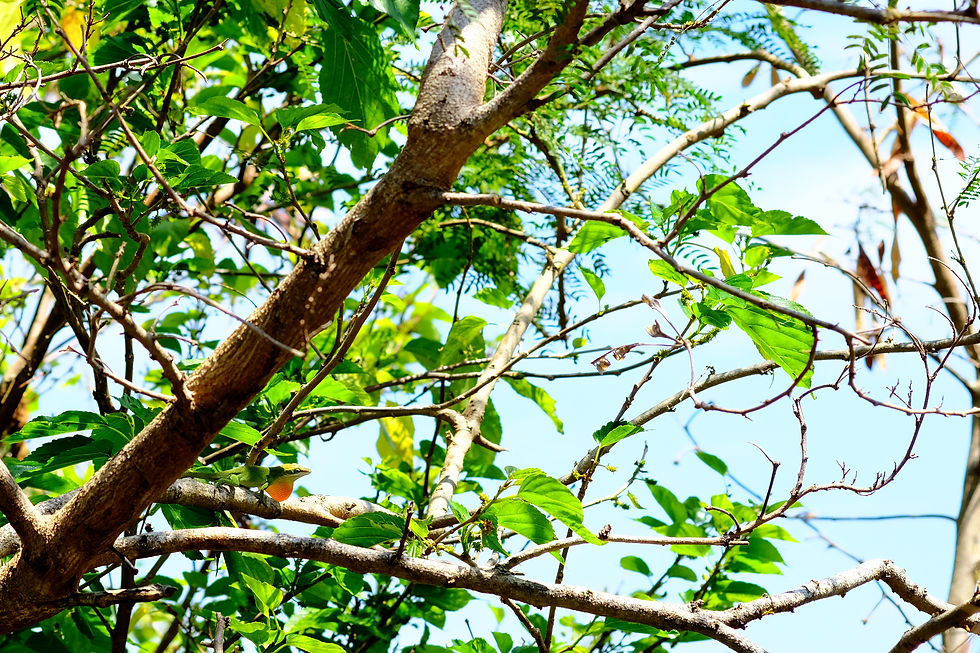
Since its arrival, the Green Anole has preyed upon arboreal insects, leading to the near extinction of several native species, including the Celastrina ogasawaraensis butterfly and several other endemic dragonfly species. Interestingly, invasive Hatian anoles have An endemic species is native to and found only in a particular habitat. Endemic species are especially vulnerable to environmental changes and invasive species, as they have evolved in isolated ecosystems without significant external pressures. This makes them more susceptible to threats posed by invasive species. These losses have rippled through the ecosystem, affecting the balance of various insect populations and further straining other native species. Additionally, the Green Anole competes directly with the endangered native lizard Cryptoblepharus boutonii nigropunctatus, fighting for habitat and resources. Remarkebly, Cryptoblepharus boutonii nigropunctatus bears a close resemblance to the Aspidoscelis sexlineata, Florida’s native Six Lined Racerunner, whom the Green Anole does not compete with. These combined pressures have made it critical for Japan to take action to manage the Green Anole population.
Approaches to control
Japan’s first attempt to control the spread of the Green Anole involved the use of Poly Tetra Fluoro Ethylene (PTFE) sheet fencing. This material is a slick, non-climbable surface that anoles are unable to scale, and it was designed to restrict the movement of these lizards into protected areas. However, PTFE fencing has limitations. While effective in some natural spaces, it cannot be easily installed in urban areas or across roads, and some anoles have found ways to bypass the fences. Given these challenges, additional methods were needed to manage the invasive species more effectively.
In a search for more effective, humane methods, Japan has turned to bioacoustics, which entails using predator sounds to deter Green Anoles. The approach involves broadcasting the calls of predators, such as the red-tailed hawk, Buteo jamaicensis, as well as alarm calls from native birds like the warbling white-eye, Zosterops japonicus. These sounds tap into the lizard’s instinctual fear of predators, causing them to avoid areas where the sounds are played. This technique allows for non-lethal control of the Green Anole, reducing their impact on native species without resorting to more harmful methods like traps or poisons.
 Japan's warbling white-eye, Zosterops japonicus. |  Japan's red-tailed hawk, Buteo jamaicensis. |
While protecting native species is crucial, we must also be cautious of approaching invasive species management with bias or discrimination. The Green Anole is not inherently “bad,” but its introduction into a new environment has thrown off the natural balance. This raises an important point: our efforts to protect native species should be grounded in a deeper understanding of the ecosystems we are managing, without rushing to label species as harmful simply because they thrive in new areas.
In South Florida, where the Green Anole is a native species, it plays an important role in local ecosystems. However, when transplanted to Japan, it has caused unintended damage. This highlights the broader lesson that even our own native species can become invasive and harmful elsewhere, and careful thought must be given to how we manage species across borders.
Japan’s use of bioacoustics to manage the Green Anole offers a humane alternative to more aggressive invasive species control methods seen in other regions. For example, in the United States, the U.S. Fish and Wildlife Service has proposed shooting barred owls to protect the native spotted owl population in the Pacific Northwest. While lethal methods like culling are sometimes seen as necessary to protect vulnerable species, they raise ethical concerns about the costs of prioritizing one species over another.
Japan’s bioacoustic approach stands out for its focus on non-lethal control. By playing predator sounds, the lizards are deterred naturally without harm, making it a more ethical and potentially long-term solution. However, its full effectiveness remains to be proven, as there is always the possibility that the anoles may adapt to the sounds or move to other unprotected areas. Nevertheless, lethal methods, while effective in the short term, can have broader consequences that may upset the ecosystem in unexpected ways.
Floridians recently voted to protect hunting and fishing as a constitutional amendment. This allows for hunting and fishing as measures for wildlife management, a vastly different approach than Japan’s bioacoustics fencing. While it has become commonplace to see nonnative species in south Florida, the greatest threat to native species is manmade. Destruction of habitats due to development, climate change, and/or pollution have led to the extinction of at least four native species in recent years, including Bachman’s Warbler.[2] While invasive species in Japan outcompete native species, thereby resulting in near extinction of endemic species, in Florida the environmental impact is less disruptive, with nonnative species occupying empty niches. Before the societies select an approach to managing ecosystems, they must first determine what the goal of control measures is.
[1] Yukari Suzuki‐Ohno, Kenjiro Morita, Nobuaki Nagata, Hideaki Mori, Shintaro Abe, Takashi Makino, and Masakado Kawata from the Department of Ecology and Evolutionary Biology at Tohoku University, in collaboration with the Ogasawara Division of the Japan Wildlife Research Center and the Naha Nature Conservation Office of the Ministry of the Environment, Okinawa, Japan
[2] Tampa Bay Times. (2023, October 17). Meet 4 native Florida species that have gone extinct. Retrieved from https://www.tampabay.com/news/environment/2023/10/17/meet-4-native-florida-species-that-have-gone-extinct/

Citations and References
1. Nucleotide sequence analysis and Green Anole's origin: Information about the origin of the Green Anole and its introduction to Japan’s Ogasawara Islands was referenced from the article, Exploration of aversive bioacoustics for the effective management of invasive green anoles (Anolis carolinensis), by Shiho, T., Sakai, O., & Iwai, N. (2022), published in the Journal for Nature Conservation. Available at: [https://doi.org/10.1016/j.jnc.2022.126215](https://doi.org/10.1016/j.jnc.2022.126215).
2. Green Anole’s impact on native species in Japan: The Green Anole's effects on native species like Celastrina ogasawaraensis and Cryptoblepharus boutonii nigropunctatus were detailed in studies such as Abe, T., Makino, S., & Okochi, I. (2008), and Toda, M., et al. (2010), as cited in the Journal for Nature Conservation.
3. Evolutionary development of Green Anoles in Florida: Information about niche segregation and the evolutionary development of larger toe pads in Green Anoles as they adapted to higher perches due to competition with Brown Anoles comes from research by Cantwell, L., & Forrest, T. (2013), and Brittan-Powell, E.F., et al. (2010) on anole behavioral ecology.
4. Bioacoustic management in Japan: The use of predator sounds as an aversive management method for Green Anoles was explored in the 2022 study by Shiho, T., Sakai, O., & Iwai, N., where they tested the effectiveness of hawk and bird alarm calls to deter Green Anoles from vulnerable areas.
5. Tampa Bay Times. (2023, October 17). Meet 4 native Florida species that have gone extinct. Retrieved from https://www.tampabay.com/news/environment/2023/10/17/meet-4-native-florida-species-that-have-gone-extinct/
6. Krebs, N. (2024, November 5). Florida voters pass 'Right to Fish and Hunt' amendment. Outdoor Life. Retrieved from https://www.outdoorlife.com/conservation/florida-right-to-hunt-fish/


Comments